

Lord of Robots
LoR Core V3
LoR Core V3
Couldn't load pickup availability
LoR Core V3
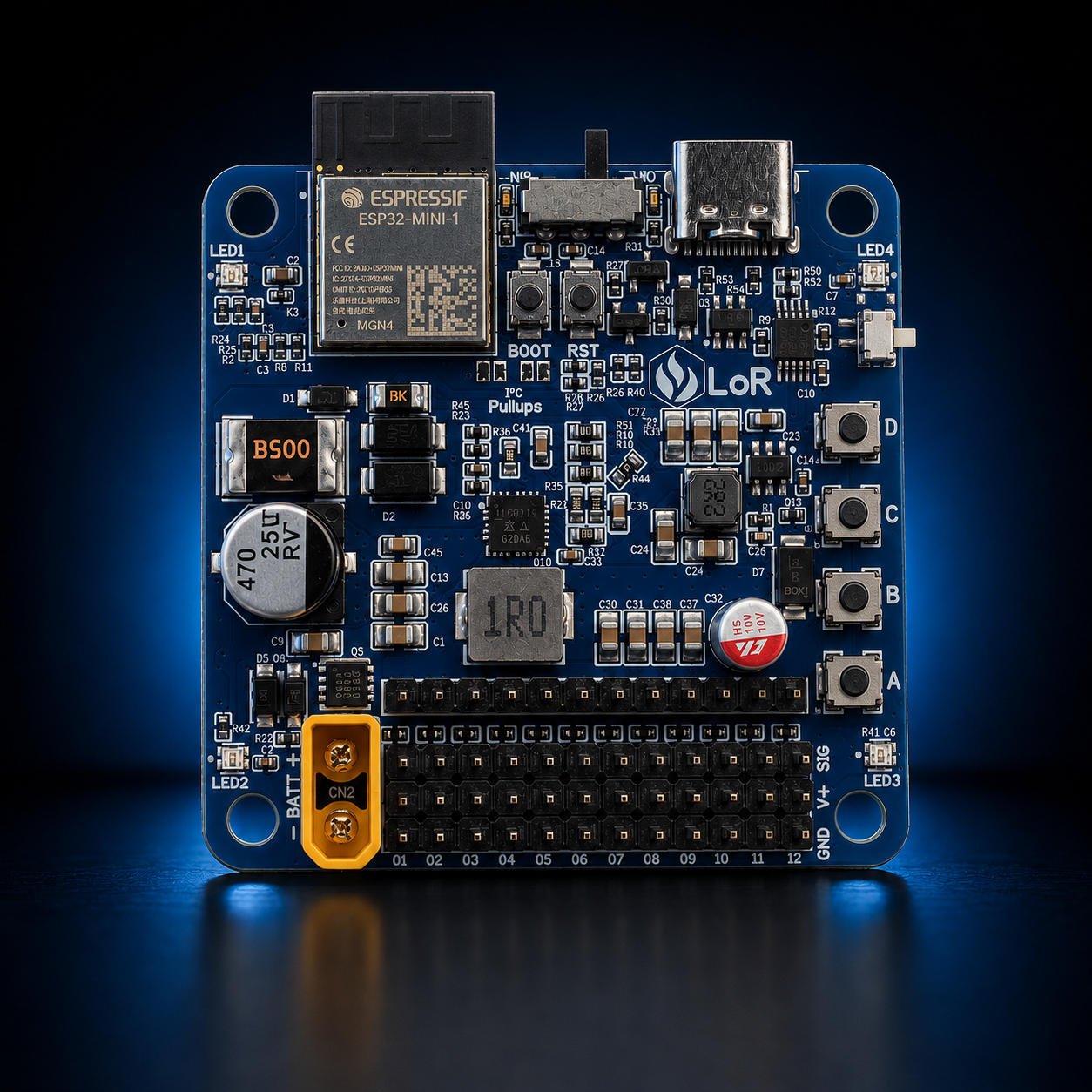
The LoR Core V3 is a compact ESP32-based robotics and embedded control platform that combines processing, regulated power distribution, wireless communication, user controls and twelve powered I/O connections on a single 50 × 50 mm board.
It is designed for mobile robots, embedded devices, educational platforms, connected products, sensor systems, animatronics and custom mechatronic applications. By integrating the controller, power system, user interface and peripheral connections, the LoR Core V3 reduces wiring, development time and the number of separate boards required to build a complete system.
Power the board from a 6–12 VDC source, connect sensors, servos, electronic speed controllers, external drivers and expansion hardware, then program and debug through USB-C.
Originally developed for the Lord of Robots MiniBot platform, the LoR Core V3 is equally suited to rapid embedded prototyping, low-volume product development and permanent installation inside finished systems.
Key Features
- ESP32-MINI-1 microcontroller
- Integrated Wi-Fi and Bluetooth
- USB-C programming and serial communication
- 6–12 VDC power input
- Integrated XT30 battery connector
- Direct battery solder pads
- Twelve powered three-wire I/O ports
- PWM and digital input/output support
- ADC capability on compatible ports
- Selectable 3.3 V, 5 V or 6 V peripheral power rail
- 5 A continuous and 10 A peak combined V+ output
- AUX header with SPI, I²C, UART, GPIO and power
- Four programmable user buttons
- One programmable slide switch
- Four addressable RGB LEDs
- Dedicated BOOT and RESET buttons
- Integrated power regulation and distribution
- Four corner mounting holes
- Compact 50 × 50 mm footprint
Integrated Control and Power Platform
The LoR Core V3 integrates functions that would normally require several separate modules:
- ESP32 processing and wireless communication
- Regulated peripheral power
- Battery or external DC input
- USB-C programming and debugging
- Sensor and actuator connections
- Local buttons, switches and indicators
- Serial and peripheral expansion interfaces
This makes it useful as both a robot controller and a general embedded system core.
Embedded and Connected Applications
The LoR Core V3 can serve as the main controller for:
- IoT devices and connected products
- Wireless sensor nodes
- Data acquisition systems
- Distributed automation controllers
- Test fixtures and production tooling
- Interactive installations
- Embedded user interfaces
- Remote monitoring systems
- Smart mechanisms and actuators
- Educational embedded systems
- Low-volume custom electronics
- Proof-of-concept product development
Its onboard buttons, slide switch and RGB LEDs can be used for setup, mode selection, calibration, diagnostics and local status indication without requiring a separate interface board.
Robotics and Mechatronics Applications
The board is also designed for:
- MiniBot and small mobile robots
- Educational robotics platforms
- Competition robots
- Servo-driven mechanisms
- Animatronics
- Wireless control systems
- Sensor-based robots
- Compact automation equipment
- Custom mechatronic prototypes
Twelve Powered I/O Ports
The twelve numbered three-wire ports provide:
- Ground
- Selectable V+ peripheral power
- ESP32 signal connection
They can be used with compatible hardware such as:
- Standard and continuous-rotation servos
- Electronic speed controllers
- Digital sensors
- Analog sensors on compatible ADC ports
- External motor drivers
- Relays and interface modules
- LEDs and indicators
- Custom peripheral boards
The shared V+ rail can be configured for 3.3 V, 5 V or 6 V, with 6 V selected by default.
The V+ output supports up to:
- 5 A continuous combined load
- 10 A peak combined load
Peak capability is intended for short-duration transient loads such as servo startup or stall events. Actual system performance also depends on input voltage, wiring, connector limits, thermal conditions and peripheral load behaviour.
AUX Expansion Header
The AUX header provides access to additional communication and expansion interfaces:
- SPI
- I²C
- UART
- GPIO
- 3.3 V power
- Ground
This supports displays, IMUs, environmental sensors, communication modules, external ADCs, storage devices and custom expansion hardware.
Wireless Connectivity
The ESP32 platform supports several communication architectures:
- Bluetooth gamepad control
- Bluetooth device communication
- Wi-Fi web interfaces
- Local network connectivity
- ESP-NOW communication
- Wireless telemetry
- Remote configuration
- Robot-to-robot or device-to-device communication
- Custom IoT protocols
The board can also operate as a fully autonomous embedded controller without an active wireless connection.
Programming and Development
The LoR Core V3 is compatible with standard ESP32 development tools and libraries, including the Arduino IDE, Codex, VS Code Platform IO and Espressif IDF.
USB-C provides programming and serial debugging. The board can be used for:
- Rapid firmware development
- Sensor integration
- Communications testing
- Hardware validation
- Closed-loop control
- Prototype user interfaces
- Wireless product development
- Embedded systems education
Software examples and documentation are available for functions including:
- Digital input and output
- PWM control
- ADC measurement
- Servo and ESC operation
- Button and switch inputs
- Addressable LED control
- Bluetooth gamepad control
- Wi-Fi interfaces
- Sensor communication
- Custom embedded applications
Documentation and software resources can also be accessed through the QR code printed on the back of the board.
Power Specifications
- Input voltage: 6–12 VDC
- Typical battery compatibility: 2S or 3S systems
- Primary power connection: XT30
- Alternate power connection: direct solder pads
- Selectable V+ output: 3.3 V, 5 V or 6 V
- Default V+ setting: 6 V
- V+ continuous output: 5 A combined
- V+ peak output: 10 A combined
Verify the selected V+ voltage before connecting peripherals. All connected hardware must be compatible with the configured rail voltage.
Compatibility Information
The LoR Core V3 does not contain integrated brushed DC motor drivers.
Brushed DC motors require an external motor driver. Standard RC servos and compatible electronic speed controllers can connect directly to the powered I/O ports.
The ESP32 uses 3.3 V logic. External hardware must use compatible logic levels or an appropriate level-shifting interface.
Not every ESP32 signal provides identical peripheral functionality. ADC and specialized interface capability depend on the assigned port and firmware configuration.
Package Contents
- 1 × LoR Core V3 controller board
- 1 × USB-C data and programming cable
- 1 × XT30 power lead
- 4 × mounting screws
Battery, sensors, servos, motors, motor drivers, electronic speed controllers and other peripherals are sold separately.
Technical Summary
| Specification | Value |
|---|---|
| Controller | ESP32-MINI-1 |
| Wireless | Wi-Fi and Bluetooth |
| Programming and debugging | USB-C |
| Input voltage | 6–12 VDC |
| Main power connection | XT30 |
| Alternate power connection | Direct solder pads |
| Main I/O | 12 powered three-wire ports |
| V+ output voltage | 3.3 V, 5 V or 6 V selectable |
| Default V+ voltage | 6 V |
| V+ continuous output | 5 A combined |
| V+ peak output | 10 A combined |
| Expansion interfaces | SPI, I²C, UART, GPIO and power |
| User inputs | 4 buttons and 1 slide switch |
| Indicators | 4 addressable RGB LEDs |
| Board dimensions | 50 × 50 mm |
| Development environment | Arduino-compatible ESP32 tools |
Share